
Oxbridge and Cambridge Economics Interview Resource Packs
The Minds Underground Economics Essay Competition
You Be The Chemist Challenge®
10000
Exceptional students submit annually
50+
Countries globally participating
4
major economics research directions
Endorsed
by colleges of Cambridge and Oxford
Winners
can be invited to MU Oxford Economics Global Championship
INTRODUCTION

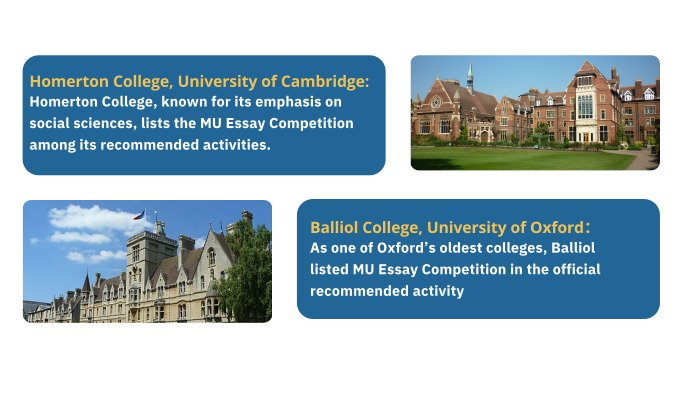
The MU Economics Essay Competition, organized by Minds Underground (MU). MU Essay Competition is officially recommended by the Balliol college, University of Oxford, and Homerton college, University of Cambridge, and is designed to empower young people worldwide to examine global issues through the lens of economics. The competition encourages students to develop critical and independent insights, while fostering a lasting passion for the subject.
Covering key subfields, the competition offers high school students a unique opportunity to sharpen their reasoning, analytical, and communication skills. With over 10,000 participants from more than 50 countries, the MU Essay Competition has grown into one of the most distinguished academic events in its field. Participation not only strengthens students’ intellectual abilities, but also enhances their academic profiles, interview performance, and university applications. Exceptional participants are further invited to the MU Oxford Economics Global Championship, where they refine their research under expert mentorship, strengthen their problem-solving and research skills, and collaborate with peers from around the globe.
Oxbridge Recommendation
2026 Economics Essay Competition Questions
Participants must select and respond to one question only, chosen from any of the four subfields listed below.
01.
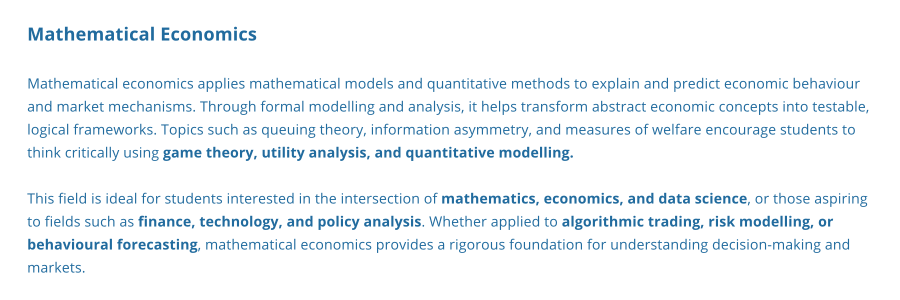
Can you use mathematics to explain why people queue at some coffee shops but not others?
Hints: Think about models of decision-making under uncertainty, externalities, pricing, or expectations. Could queuing be a rational signal of quality? Use game theory, utility models, or network effects.
02.
Imagine a world where everyone has perfect information. What changes in how markets work?
Hints: Explore market efficiency, price discovery, asymmetric information, and the role of speculation or advertising.
03.
How would you design a mathematical model to measure “economic happiness”?
Hints: Define what variables matter (e.g. income, leisure, inequality). Consider utility, GDP alternatives, or wellbeing indexes. How would you test or apply it?
01.
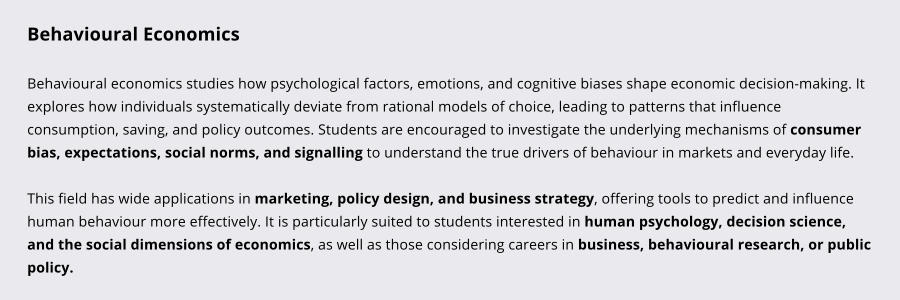
Why do people tip in restaurants they’ll never return to?
Hints: Explore social norms, reciprocity, self-image, and irrational generosity. Consider experimental findings.
02.
If humans were truly rational, would supermarkets still exist in their current form?
Hints: Think about pricing psychology, choice architecture, and impulse behaviour. Consider how shopping would change in a hyper-rational world.
03.
Why do people pay more for branded water? Can behavioural economics fix this?
Hints: Explore perceived value, framing, signalling, and consumer biases. What policies (if any) should intervene?
01.
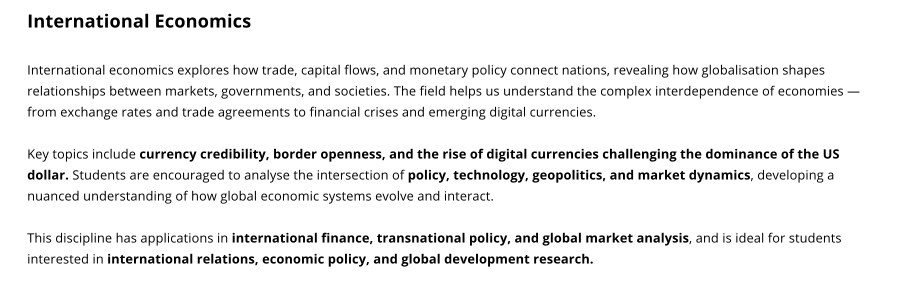
A new country is formed and launches its own currency. What determines whether the world takes it seriously?
Hints: Consider monetary policy, central bank credibility, geopolitical alliances, and investor confidence. Case studies welcome!
02.
What would happen if all borders were opened overnight?
Hints: Explore the flow of labour, capital, and goods. Discuss short- and long-term impacts, institutional strain, and economic opportunity.
03.
Could a digital-only currency replace the US dollar as the world’s reserve?
Hints: Compare digital currencies vs. fiat; look at trust, power, and technological infrastructure. How do politics and finance intersect?
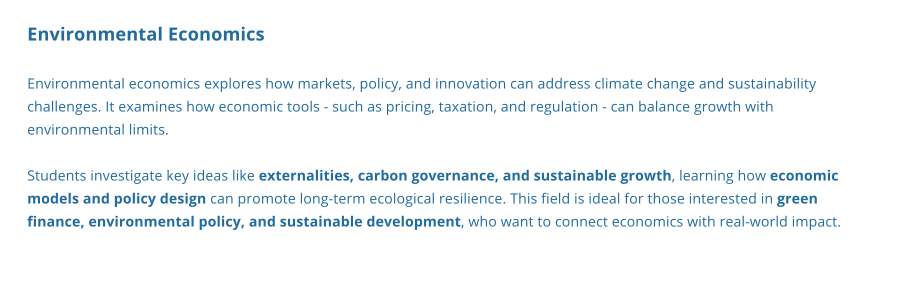
01.
Should we put a price on nature?
Hints: Think about ecosystem services, externalities, and valuation methods. Explore whether economic tools can meaningfully capture environmental value.
02.
If climate change were a company, how would you bankrupt it?
Hints: Think creatively – consider subsidies, taxes, lawsuits, social pressure, or innovation. Can market mechanisms “defeat” emissions?
03.
Is infinite economic growth on a finite planet a myth or a misunderstood goal?
Hints: Challenge GDP as the primary measure of progress. Explore the circular economy, decoupling, or alternative definitions of “growth” in an ecological context.
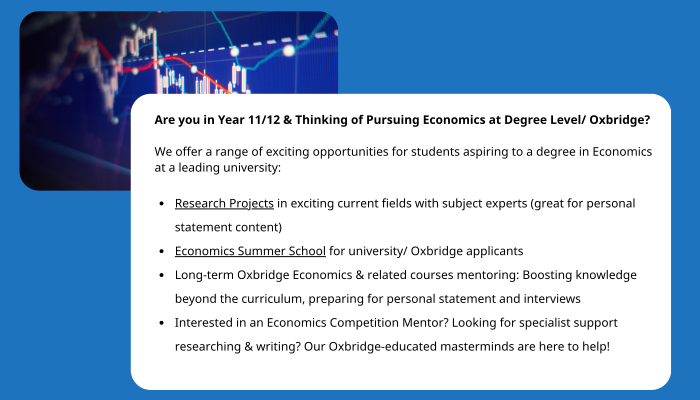
N.B. You may be interested in undertaking one of MU’s Economics masterclasses with our experts to give you ideas and help direct your research. Some examples are listed below!

Modelling Technological Innovation and Change

Motivation, Job Performance And Job Design

Game Theory

The Basic Micro-Economic Assumptions

Behavioural Economics and the Real World

FANG – Facebook, Amazon, Netflix, Google

Will Disruptive Technologies Have the Effect Predicted?

The Economic History of the World

Globalisation and Inequality

Are the Pursuit of Growth and a Sustainable Environment Compatible?


Economics Essay Competition FAQs
1. Why should you enter our Economics Essay Competition?
Our Economics Essay Competition is a fantastic opportunity to strengthen your university application by showcasing your dedication to exploring an independent interest in economics. By taking part, you’ll develop essential skills in research, planning, and critical analysis—all highly valued by admissions tutors.
2. Who is eligible to enter the Economics Essay Competition?
Open to all students in the UK and internationally! It is especially recommended for Year 12 students or gap-year applicants preparing to reapply to university, though younger students with a passion for economics are also encouraged to participate.
3. Can I receive support for the Economics Essay Competition?
Absolutely! Work alongside one of our experienced Economics Essay Competition mentors for assistance with interpreting questions, conducting research, and structuring your essay. Our mentors will also provide detailed feedback on your drafts. Many of our mentors have studied Economics at Oxbridge and can guide you through every stage of the process.
4. Can I submit multiple entries?
Only one entry is allowed per subject, but you’re more than welcome to submit an essay in a different competition subject!
Advancement system
Rule
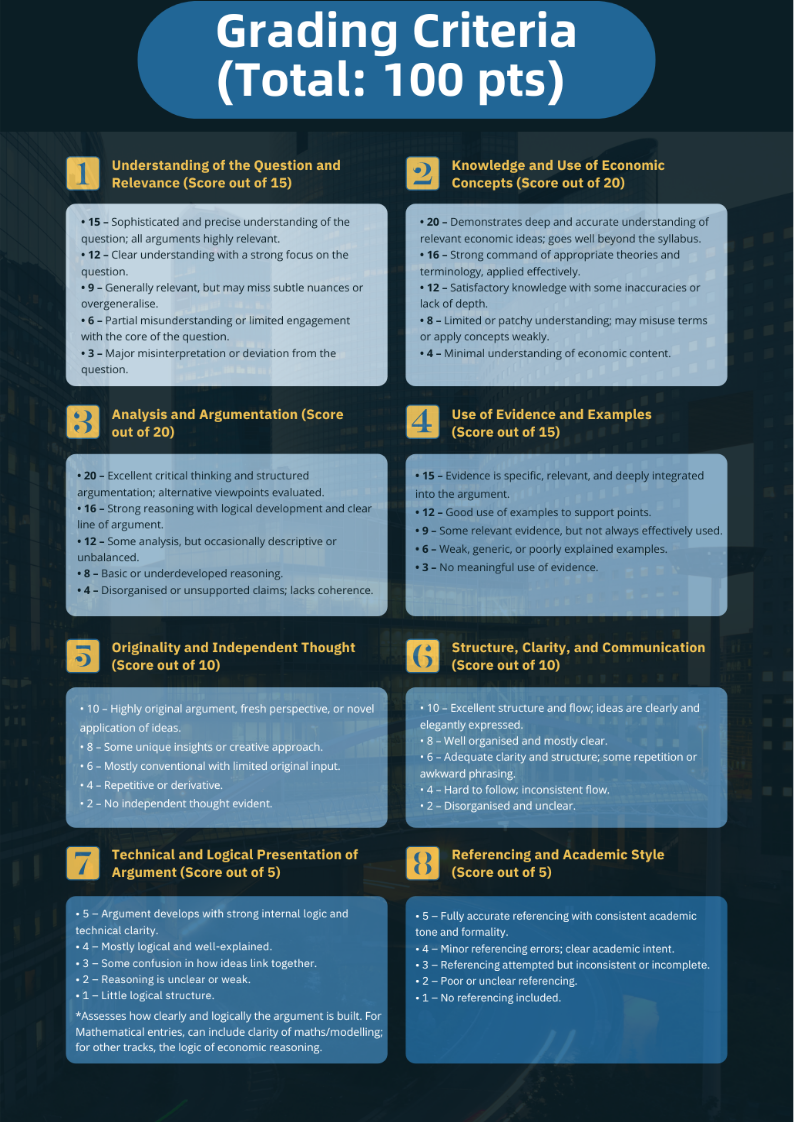
- How to Participate: Online submission. Choose a topic from the list and write an essay.
- Topic Selection: MU would set different topics around current important issues annually. For 2025–2026, MU focuses on four major economics subfields, and adopts open-ended questions to encourage critical analysis from multiple angles (e.g., theory, data, policy). Originality and reasoning matter more than format.
- Essay Requirements:
-
- English, 1,000–1,500 words (References are not included in the word count).
- Harvard referencing style.
- No more than 2 authors per essay.
- Eligibility: 15 -18 years old
- Registration Deadline:January 15, 2026
- Theorganizing committee will dynamically assess the registration number. If the upper limit forreview is reached before the deadline, the registration channel will be closed in advance.
- Therefore, it is recommended that students sign up as early as possible to ensure their qualification for the competition.
- Submission deadline:March 15, 2026.
Award
The essay awards will be announced in April 2026, with outstanding winners invited to Oxford for the MU Oxford Economics Global Championship.
Guided by leading economics mentors, students will engage deeply with the essence of economic issues, sharpen their critical thinking and research abilities, and develop rigorous, innovative solutions. By collaborating with peers from around the world, participants will not only showcase their individual research achievements but also broaden their horizons and enrich their perspectives. The Championship will culminate in the recognition of the most exceptional economic papers and presentations, celebrating the insight and creativity of the next generation of global economists.

The overall award-winning ratio is 60%, and the specific number of awards is determined based on the quality of student submissions
Useful Economics Resources
These economics resources might offer some useful independent reading tips for our Economics essay competition, or help you prepare an Oxbridge Economics application.

Applying for Economics & Management
Oxbridge Economics Interview Questions

Includes the exam, grading, proctor fee, past-papers, certificates.
registration deadlineJanuary 15, 2026